

As the Lead Product Analyst at Shaving Emporium, I approach the safety razor market with a focus on technical engineering, not aesthetics. The safety razor provides the closest, most efficient shave possible, but only if you select the correct tool for your skin and beard density.
This guide moves beyond simple price points to analyse the core metrics that determine shave quality: Blade Gap (mm), head geometry, and the resultant Aggressiveness Rating.
We use this data to match the razor's technical specifications to your individual shaving profile, ensuring a close shave without the irritation or nicks commonly caused by mismatched equipment.
⚠️ METHODOLOGY DISCLOSURE: All recommendations at Shaving Emporium are based on seven years of expertise, synthesized from verified UK consumer reviews, technical product specifications, and formulation analysis. I provide an expert data-driven perspective to guide your purchase.
Expert Comparison Table: Technical Metrics
Rank | Razor Model | Aggressiveness Rating (1-5) | Blade Gap (mm) | Head Design | Ideal Use |
|---|---|---|---|---|---|
#1 | Merkur 34C HD | 2.5/5 | 0.71mm | Closed Comb | Daily Shaving, Beginners |
#2 | Mühle R41 | 5/5 | 0.85mm | Open Comb | 3+ Days Stubble, Experienced |
#3 | Edwin Jagger DE89 | 2.0/5 | 0.7mm | Closed Comb | Sensitive Skin, Light Beard |
#4 | Parker Semi-Slant | 3.5/5 | Varies | Slant bar | Coarse Beard, Moderate Irritation |
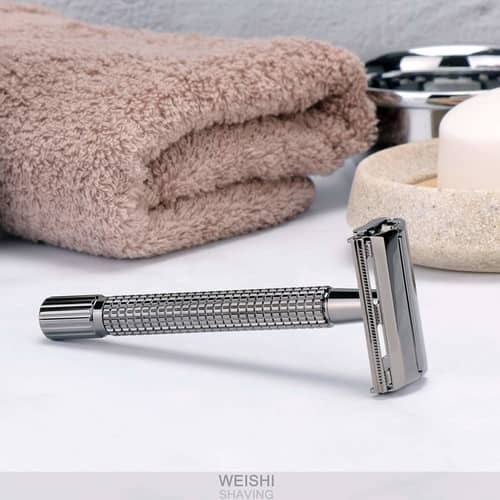
#5 | Weishi 9306C | 1.5/5 | 0.61mm | Closed Comb | High Sensitivity, First-Timers |
The Science of Aggressiveness: Blade Gap and Head Geometry
Blade Gap (Aggressiveness Index)
This is the distance between the razor's guard bar and the blade edge.
- 60-75mm (Mild): The blade is mostly protected by the guard, minimizing direct skin exposure. Ideal for light to medium growth and sensitive skin.
- 76-90mm (Medium/Aggressive): Exposes more blade edge, requiring fewer passes but demanding greater skill.
- 90mm+ (Highly Aggressive): Only for experienced shavers with very coarse, dense growth.
Head Design
- Closed Comb (Standard): Features a straight, closed bar beneath the blade to flatten the skin and control the blade exposure. This is the safest design for daily shaving.
- Open Comb (Aggressive): Uses widely spaced teeth, which lifts the hair more aggressively and exposes more blade. Best for 2 to 3 day growth but high risk for daily users.
- Slant Bar: Twists the blade to create a scything action. Excellent for coarse, dense beards as it
Detailed Reviews
1. Merkur 34C HD: The Technical Baseline
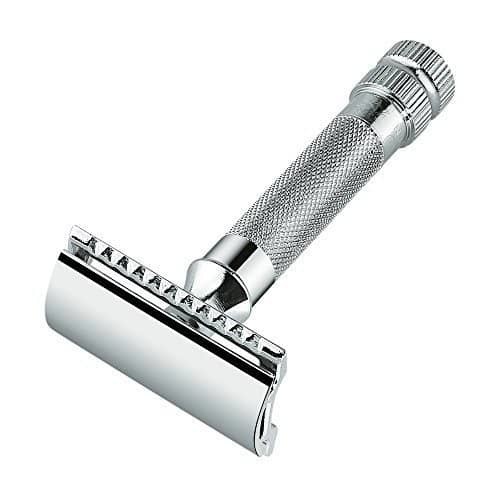
- Analyst Report: The Merkur 34C is the industry standard for a reason. Its precisely engineered 0.71 mm Blade Gap places it squarely in the mild-to-medium range (2.5 Aggressiveness). This gap provides enough efficiency to handle daily stubble without the risk of nicks associated with higher gaps. The heavy, short handle ensures the razor's weight (Heavy Duty) does the work, forcing the user to adopt the crucial light-pressure technique, which minimizes skin drag and irritation.
2. Mühle R41: The Aggressive Expert Tool
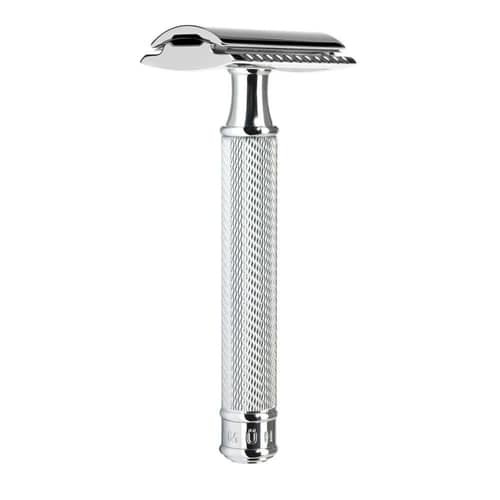
- Analyst Report: The Mühle R41 is considered the most aggressive production razor available and is explicitly not recommended for beginners or daily shavers. This is due to its large blade Gap (0.85 mm) combined with an Open Comb head Design. This combination maximizes the blade exposure and skin stretching, requiring minimal passes to cut through 3+ days of coarse growth. Its 5.0 Aggressiveness Rating reflects the demand for absolute mastery of the zero-pressure technique; any deviation will likely result in nicks and irritation. Its primary value is efficiency for very experienced shavers with dense beards.
3. Edwin Jagger DE89: The Sensitive Skin Standard
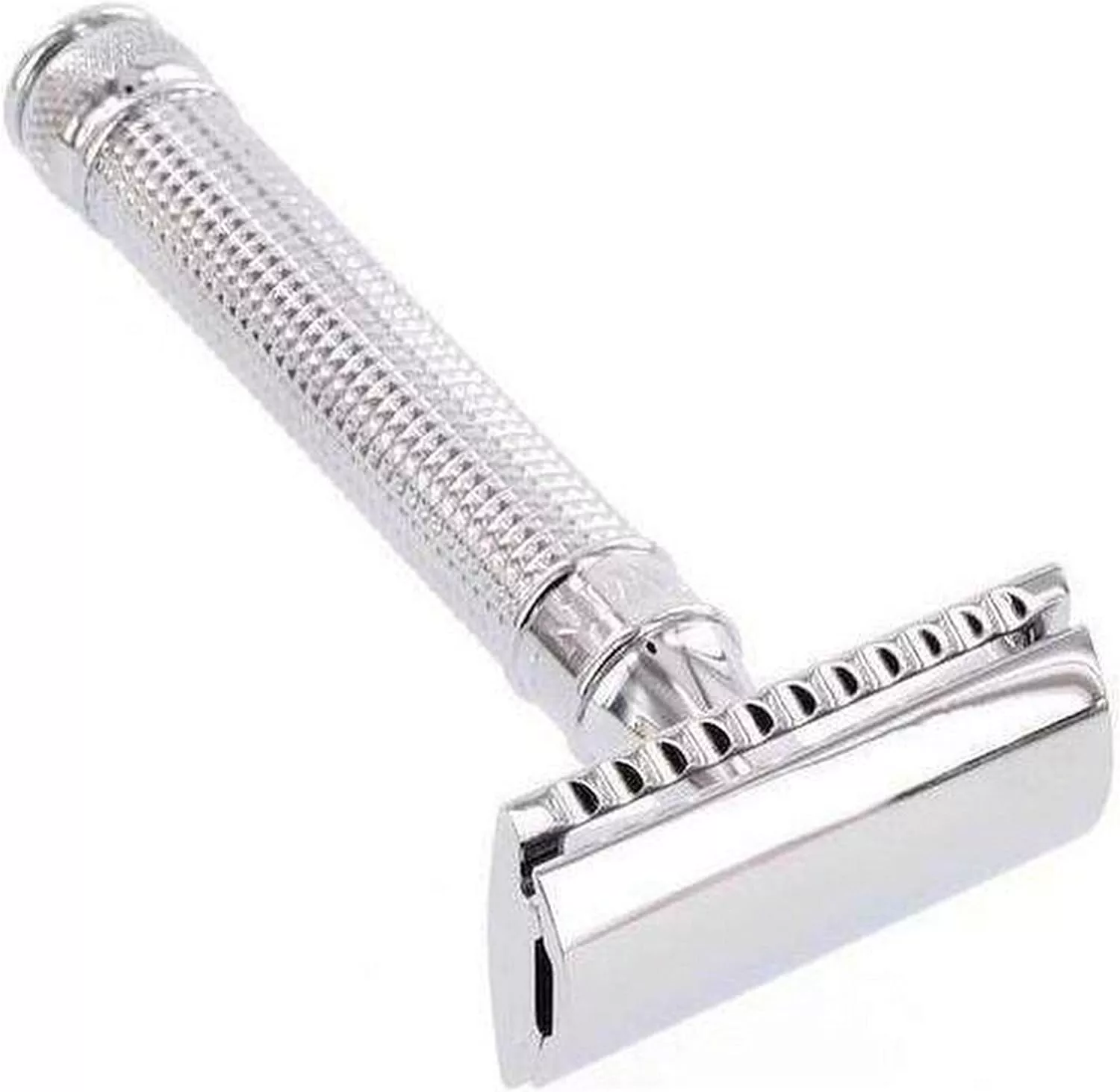
- Analyst Report: The Edwin Jagger DE89 is the benchmark for mild, sensitive shaving. With a very tight blade gap (0.7 mm) and a classic closed comb head, it provides maximum protection to the skin barrier. The razor's head design minimises the blade exposure, making it extremely forgiving of poor technique or slight angle variations. Its 2.0 Aggressiveness Rating makes it the preferred starting recommendation for any new safety razor user or those with highly reactive skin who require a reliable daily shave with minimal risk of irritation
4. Parker Semi-Slant: The Efficiency Specialist
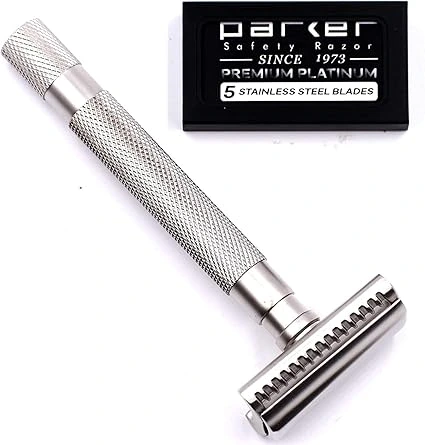
- Analyst Report: The Parker Slant design introduces a technical variable known as the "guillotine effect." By twisting the blade slightly as it is clamped, the blade slices the hair at an angle rather than chopping straight on. This specialized design reduces the overall drag and required force, making it highly efficient for coarse, wiry beards that typically cause tugging. With a 3.5 Aggressiveness Rating, it is suitable for intermediate users who need more efficiency than the DE89 but find the R41 too dangerous.
5. Weishi 9306C: The Ultra-Mild Introduction
- Analyst Report: The Weishi 9306C is classified as an ultra-mild, entry-level razor. Its extremely small blade gap (0.61 mm) offers minimal blade exposure, giving it an Aggressiveness Rating of 1.5. Its primary function is to serve as a training tool. It forces the user to apply almost zero pressure while providing high security. While it may require more passes to achieve a close shave on dense growth, its low risk profile makes it the optimal choice for the absolute beginner learning the crucial 30-degree angle.
Conclusion
Double edge safety razors are in fact making a comeback. They were popular in the UK during the 1950-1960 period, but fell out of fashion as disposable shavers, cartridges shavers and electric shavers were introduced to the UK market. Those were of course designed to make shaving faster and easier.
Choosing a safety razor is not a matter of brand loyalty; it is a technical decision based on your skin type and stubble density. New users must start with a mild, low-gap75mm razor like the Edwin Jagger DE89.
Progressing to aggressive open-comb designs before achieving proficiency will only lead to poor results. Master the basics, and the closeness of your shave will improve exponentially.
The 3 Crucial Principles of Safety Razor Shaving
We found this very useful video that shows you how to shave with a safety razor the right way. There is a technique to using one of these, but the good news is that it really does not take that much practise to master the art. The main thing is to never push or press one of these into your face.
The weight of the razor takes care of the cutting, and preparation of the skin is thee most important thing to get right.
- The 30-Degree Angle: This specific angle provides optimal blade exposure and is the ideal angle you should hold the razor against your skin..
- Weight vs. Pressure: The razor's weight will do the work so there is no need to apply any pressure to your razor.
- Short Strokes: Avoid long strokes as they increase the risk of cutting the skin.
We hope that we have provided you with enough information on the best safety razor in the UK. Any of the DE razors mentioned on our list are very good quality. It is then just a matter of picking the design, style and price that you like the best.
FAQ
Open Comb vs Closed Comb Safety Razors?
When purchasing a safety razor, it is important to understand the difference between an open comb and a closed comb.
Closed Combs
A closed comb razor is the best choice for a beginner or for anyone new to this type of wet shaving. It is also the better choice for anyone who wants a less aggressive shave. We would also recommend this option for anyone who has sensitive skin, or is prone to cuts and nicks.
That is because with a closed comb DE razor, the blade is better protected. Slightly less of the blades is exposed to the skin. The closed comb is the most popular of the two options.
Open Combs
As you would imagine there is less coverage of the blade, so more of it is exposed. If you have been wet shaving for years then many men will make the move to this type of DE safety razor. It is slightly more aggressive and that also makes it a better choice for those with tougher skin types.
What does DE mean when you see the term DE Safety Razor?
DE stands for "Double Edged." This simply means that when you insert a razor blade into the safety razor, and close it, then you have an edge of the blade on two sides of the razor.
In other words a double edge. It is not any more complicated than that. When you buy razor blades you can either buy them with one cutting edge or with two cutting edges. For shaving purposes they are always sold as double edged. The single edged types are used by artists for sharpening pencils etc.
Long Handle vs Short Handle
You will also see this description when it comes to buying a safety razor. The easiest way to think of this is that long handled razors are used by people with larger hands. Now any man or woman can use a long handled razor, but anyone with larger hands will struggle to use a short handled razor.