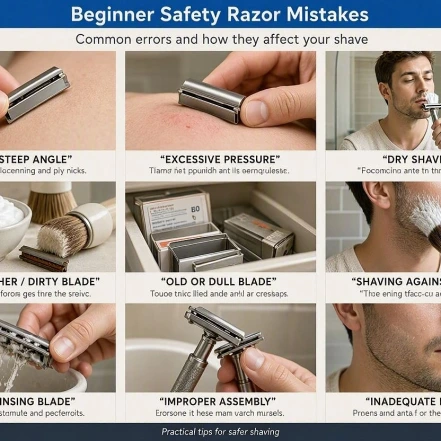
Switching to a safety razor is one of the best upgrades you can make to your shaving routine — but beginners often run into the same problems: razor burn, tugging, nicks, patchy results, or feeling like the razor “isn’t cutting”.
The good news? Almost all beginner mistakes are easy to fix once you know what’s going wrong.
This guide explains the most common safety razor mistakes and how to correct them so you can shave comfortably and confidently. Read our Complete Safety Razor UK Guide.
Quick Summary
Beginners usually struggle with:
- Using too much pressure
- Holding the wrong angle
- Poor lather
- Shaving too fast
- Using the wrong blade
- Shaving against the grain too early
- Not stretching the skin
- Over‑shaving the same area
Fixing these transforms your shave instantly.
Mistake 1 — Using Too Much Pressure
Cartridge razors require pressure. Safety razors do not.
Beginners often press the razor into the skin, causing:
- Razor burn
- Redness
- Nicks
- Over‑shaving
Fix:
Let the razor’s weight do the work. Hold the razor lightly — like holding a paintbrush, not a hammer.
If you’re new to technique, read “How to Shave With a Safety Razor (Step‑by‑Step UK Guide)”.
Mistake 2 — Wrong Shaving Angle
Safety razors work best at around 30 degrees. Beginners often:
- Hold the handle too upright (too steep)
- Lay the razor too flat (too shallow)
Both cause tugging or missed hairs.
Fix:
Start with the razor head flat against your cheek. Slowly lower the handle until you feel the blade just begin to cut.
That’s your angle.
Mistake 3 — Poor Lather
Thin, dry, or airy lather causes:
- Dragging
- Irritation
- Patchy shaving
- Blade skipping
Fix:
Build a wet, creamy lather that provides cushion and glide.
If your lather dries on your face, add more water.
Mistake 4 — Shaving Too Fast
Safety razors reward patience. Rushing causes:
- Nicks
- Missed patches
- Wrong angle
- Over‑shaving
Fix:
Use short, controlled strokes — especially on the neck. Visit our Safety Razor Troubleshooting: Fix Razor Burn, Tugging & Nicks guide
Mistake 5 — Using the Wrong Blade
Beginners often choose blades that are:
- Too sharp (Feather)
- Too dull (Derby Extra)
- Inconsistent
This leads to tugging, irritation, or unpredictable results.
Fix:
Start with beginner‑friendly blades:
- Astra Superior Platinum
- Personna Platinum
- Wilkinson Sword
- Gillette Silver Blue
Read “Best Safety Razor Blades for Beginners (UK Guide)” for full recommendations.
Mistake 6 — Shaving Against the Grain Too Early
ATG (against the grain) gives the closest shave — but it’s also the most likely to cause irritation.
Beginners often go ATG before their skin is ready.
Fix:
Use this order:
- With the grain (WTG)
- Across the grain (XTG)
- Against the grain (ATG) — only when comfortable
If you get irritation, skip ATG for a week.
Mistake 7 — Not Stretching the Skin
Loose skin folds cause:
- Nicks
- Uneven cutting
- Missed hairs
Fix:
Use your free hand to gently stretch the skin, especially on:
- Neck
- Jawline
- Chin
- Upper lip
This gives the blade a smooth surface.
Mistake 8 — Over‑Shaving the Same Area
Beginners often go over the same spot repeatedly, causing:
- Razor burn
- Redness
- Micro‑cuts
Fix:
Let each pass do its job.
If you miss hairs:
- Re‑lather
- Adjust your angle
- Use short strokes
Never dry‑shave a missed patch.
Mistake 9 — Using the Wrong Razor for Your Beard Type
A mild razor can tug on coarse stubble. An aggressive razor can irritate sensitive skin.
Fix:
Match razor to beard type:
Light to medium stubble:
- Edwin Jagger DE89
- Merkur 34C
Coarse beard:
- Rockwell 6C (R4–R6)
- Mühle R41
Read “Open Comb vs Closed Comb Safety Razors: What’s the Difference & Which Should You Choose?”.
Mistake 10 — Poor Prep
Skipping prep leads to:
- Tugging
- Irritation
- Rough shave
Fix:
Do this every time:
- Wash face with warm water
- Hydrate beard for 30–60 seconds
- Apply pre‑shave or a slick soap
- Build proper lather
Prep matters more than the razor.
Final Recommendation
Safety razors reward good technique — and once you fix these beginner mistakes, you’ll get smoother shaves, less irritation, and far better results than any cartridge razor can offer.
Master the basics, choose the right blade, and let the razor do the work.